Magical Realism, Writing, Fiction, Politics, Haiku, Books


sábado, septiembre 08, 2012

Shopping For Tequila In Cancun Airport

Blue Agave (Agave tequilana)


Your Bloguero is a frequent flyer between New York and Cancun’s Airport. It’s an airport designed so that when you are catching a departing flight, you have to walk through the Duty Free Store. You might even have to walk through three of them, as your Bloguero did this week. Is that why they tell you to arrive at the airport three hours before an International Flight? Maybe.

Your Bloguero likes to bring tequila home. Specifically, premium, 100% blue agave tequila blanco, which looks clear. He likes to put it in the freezer, get it extremely cold, and drink it straight up. No salt. No lime. No ice. No nothing. A shot in a really nice Mexican tequila shot glass. The quality and taste of the tequila are extremely important. One does not do this with the cheapass Cuervo Tequila you might find in Gingolandia’s many mall liquor stores. Really. Do not try this with that stuff. Do not.

In the Cancun duty free, they are equipped to let you taste tequila before you buy a bottle. Remember this. This could be very valuable to you: they will let you taste before you buy. They will pour you samples.

Usually, your Bloguero looks for and sometimes buys a bottle of Don Julio Blanco. It costs about $US26. Your Bloguero likes this tequila. He endorses your drinking it. It easily meets all of his many, finicky specifications. Your Bloguero has also purchased other tequilas at Cancun’s Duty Free. But first he has to taste them. This is the key.

Here’s some free advise about shopping for Tequila in Cancun Airport: Go to the duty free and intend to buy at least one bottle of great tequila blanco to take home. Tell the salesperson you want to buy a bottle of Don Julio Blanco, but you wonder whether they have anything that might be even better. The same price, or maybe a little more. Of course they do. What do they recommend? Look: they have tons of tequila, they have bottles that cost up to $200 per bottle, brands you have never heard of (unless you’re exploring the vast, premium tequila market on a regular basis, or its your job), brands you cannot readily get outside of Mexico, brands that are too small to export. They are justifiably very proud of what they have. And what they have is really good.

The salesperson will respond by offering you some tastes of various tequilas in little plastic cups. They will open bottles and pour you samples. Note: the samples are going to be at room temperature. This is salient in deciding what is going to be really smooth when it’s incredibly cold. Some of these are incredibly smooth at room temperature, and have a wonderful nose. Put another way, when you get this tequila really cold, it’s going to be even smoother. It’s going to be like syrup when it’s cold. You can sip these or chug these samples. They do not care. They probably wish they were allowed to sample. And they will keep this tequila flowing in the little cups until you decide something, or become incapable of making a decision.

Long story short: after 6 or 7 tastes (who’s keeping count) and rejecting a very smooth, expensive Cuervo Reserve just because of its name (read: your Bloguero is a complete tequila snob), your Bloguero bought two bottles, neither of which is made by Don Julio. Less than $US80 total. These are now in your Bloguero’s freezer.

No, your Bloguero is not telling you what he bought. That’s a secret for now. And that’s another post. After your Bloguero drinks the new tequilas and decides whether they are as good as he anticipated they would be, you will learn what he bought. And how he found it.

Meanwhile, your Bloguero highly, highly, highly recommends, if you’re flying out of Cancun Airport, that you have 6, 7, maybe even 8 samples of top of the line tequila, buy a nice bottle or two or three to bring home, and have an extremely tranquilo vuelo to wherever you’re headed. This is the great pleasure of Cancun’s Airport. Do not miss it.

The title is an homage to Jeff Greenwald’s 1996 classic “Shopping For Buddhas”.


Etiquetas: , , , ,

martes, agosto 21, 2007

Homenaje a Cancun


Cancun, despite whatever anybody may have told you, is a literary destination after all. It has fewer bookstores per capita than even Las Vegas. But to its credit, there is a Mayan guy who wanders up and down the beach with a sandwich board. It says, "Beer 20 pesos, Used books 15 pesos, Villanelles 30 pesos, Sestinas 30 pesos." Is this some kind of joke, I wonder. Evidently not. I spent a grand total of US$6.50. I got a very cold Superior beer with a slice of lime, a used copy of Roberto Bolano's Night in Chile, and a sestina. The sestina was unusual and somewhat disappointing. It was mostly words in Mayan but rounded itself out by having the rhymes in Spanish. I was impressed. Others might not be. But seriously, what kind of sestina can you get anywhere else for US$3.00? Or more bluntly, how many rhymes can you get for US$3.00, forget about what language they might be in.

In his novel, Diana, which is not his best work by a long shot, Carlos Fuentes complains about the quality of paper in Mexico. It's cheap, but the pen goes through the page, and the pages disintegrate in the humidity. The pages don't smell good either. OK. He won the Cervantes prize so he knows about this. And he's Mexican. Fine. So I needed a notebook on June 7, 2007. In Super Mar Caribe, my favorite small mini mart, I found one. It is perfect. It has squares on every page and on the cover a picture of Tweety Bird kicking a soccer ball and the logo of the Mexican Football Team. It's about the run up to the 2006 World Cup, and it says, "Nos vamos al mundial!!" It was US$2.50. It says in small print on the back that it was made in Chile. There are dozens more of these on the shelf. There are enough to give every single writer in Quintana Roo a chance. A chance to wander the beaches of Cancun selling beer and haikus, fruit juice and essays, ice cream and used books.

Etiquetas: , , ,

viernes, agosto 17, 2007

Some Perspective, Please

cross posted from dailyKos

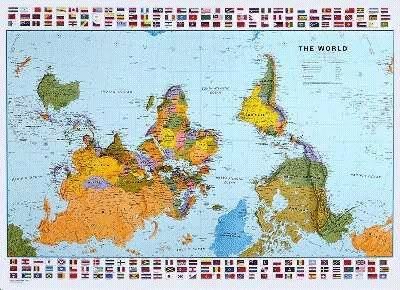
Habit is an amazing blocker of perception. It keeps thoughts within particular, constantly used, familiar channels. An example. Think for a second, if you will about what a map of the world looks like. Do you think in mercator projection? In your map, which you probably saw in classrooms, Greenland and England are enormous. And then there's this:
Photo Sharing and Video Hosting at Photobucket

There is, of course, no scientific reason why Europe and America should be at the top and Africa and South America should be at the bottom. But if we want to understand how ingrained in our thinking American exceptionalism is, the "upside down" map is a good place to begin.

There are historical reasons for perceptions. There are habitual reasons. There are artificial reasons. Sometimes we don't even recognize when our thinking is stuck in the habitual channel. The channel I'm thinking about at the moment is the belief that the US is the center of the world, that the planet revolves around the US, and that, therefore, the US is special, the US is , well, exceptional. Special.

One of the habitual thoughts most US citizens dwell on is that the rest of this hemisphere doesn't really exist, that it's essentially unimportant to us even though it is so very close to us. It is there for the US to exploit, but it is not of the same value as the US. It is somehow less, somehow not as vital, somehow not as important.

US citizens, for example, know about the destruction brought to the US by Hurricane Katrina. But fewer of us noticed that Hurricane Wilma destroyed Cancun, and even fewer of us noticed that unlike New Orleans immediate repairs to Cancun was a top priority of the government. While New Orleans still suffers, as far as I can tell Cancun has been fully repaired and, as they say, "Cancun esta de pie."

Which brings me to the present hurricane season, which has begun too soon. Tropical Storm Erin flooded Texas. We paid attention to that storm, of course, because it landed in Texas. We thought whatever thoughts we thought about how increased hurricane activity is related to global warming, and how that means that more damage might be done in the US. We thought that Erin seemed to be hitting early in the season, and maybe that meant there would be more hurricane activity this year than last year and more damage to the US.

But what of those storms that probably won't hit the continental United States, storms like Hurricane Dean, which is thrashing around in the Caribbean at this very moment? If a hurricane comes ashore in a country that is not the US, is it still a hurricane? If a tree falls in the forest, and no one...

NEW YORK (Reuters) - Hurricane Dean, which could strengthen into a Category 4 hurricane over the next two days, pounded the eastern Caribbean islands of Martinique and Dominica as it churned into the Caribbean Sea.

And next week Dean will likely enter the Gulf of Mexico, threatening the region's oil and natural gas facilities, which account for roughly a third of U.S. oil production, the National Hurricane Center predicted.

Overnight Dean strengthened into a Category 2 hurricane, with winds near 100 miles per hour

According to Reuters, it's too early to know where Dean will come ashore.
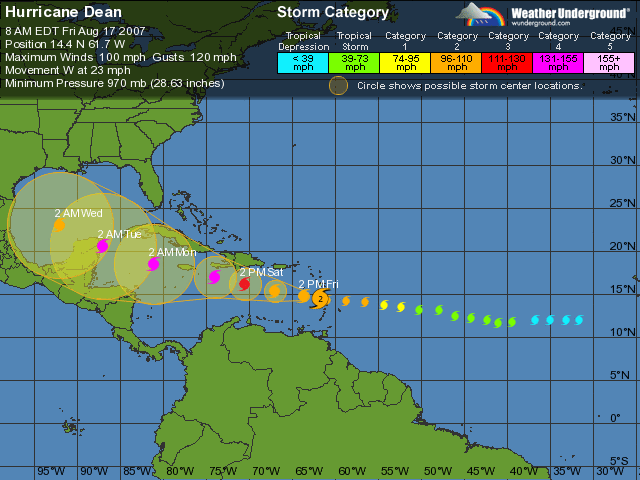
But Weatherunderground has this very disquieting map:

Photo Sharing and Video Hosting at Photobucket

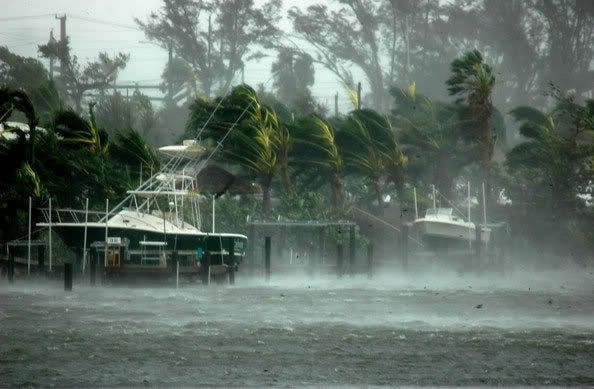
And this map looks to put Dean on a track like Hurricane Wilma, which destroyed Cancun two years ago. Maybe you can remember Wilma:

Photo Sharing and Video Hosting at Photobucket

I remember it very well. And I remember the reconstruction and what some felt was the death of the tourist industry in Quintana Roo, Mexico. But this isn't about me, or hurricanes, or Quintana Roo. Or my house in Bahia Soliman, Tulum, Municipal. Solidaridad, Quintana Roo. It's about our thinking.

Wouldn't it be amazing if when we looked at the storm map of Hurricane Dean we could recognize the connections we have with the rest of this hemisphere? Wouldn't it be remarkable if instead of looking immediately for the border between the US and Mexico, something that might disconnect us from the storm, we could perceive our connectedness? Wouldn't it be amazing if it didn't really matter to us in which country Dean was going to land? And isn't this the very shift we have to begin to make in our thinking if we want to get to the roots of American exceptionalism and dig them up?

Etiquetas: , , , ,