Magical Realism, Writing, Fiction, Politics, Haiku, Books


jueves, octubre 07, 2010

Vargas Llosa Win Nobel Prize

Mario Vargas Llosa has won the Nobel Prize for literature:

Peruvian Mario Vargas Llosa won the 2010 Nobel Prize in literature on Thursday as the academy honored one of the Spanish-speaking world's most acclaimed authors and an outspoken political activist who once came close to being elected president of his tumultuous homeland.
Vargas Llosa, 74, has written more than 30 novels, plays and essays, including "Conversation in the Cathedral" and "The Green House." In 1995, he won the Cervantes Prize, the most distinguished literary honor in Spanish.

"I am very surprised, I did not expect this," Vargas Llosa told Spanish National Radio, adding he thought it was a joke when he received the call.

"It had been years since my name was even mentioned," he added. "It has certainly been a total surprise, a very pleasant surprise, but a surprise nonetheless."

But, of course, there's then the inside baseball:

Vargas Llosa is the first South American winner of the prestigious 10 million kronor ($1.5 million) Nobel Prize in literature since Colombian writer Gabriel Garcia Marquez won in 1982.
The two have long been rivals, and after the announcement Garcia Marquez tweeted: "cuentas iguales" — "now we're even" in Spanish.

And, of course, the gossip:

Vargas Llosa has feuded with Venezuela's leftist President Hugo Chavez and often tosses barbs at Cuba's Fidel Castro. He reportedly has not spoken in decades with Garcia Marquez, a former friend who remains close to Castro.

He even irritated his centrist friend Octavio Paz, the late Mexican Nobel literature laureate, by playfully describing Mexico's political system — which was dominated at the time by a single party — as "the perfect dictatorship."

In a famous incident in Mexico City in 1976, Vargas Llosa punched out Garcia Marquez, whom he would later ridicule as "Castro's courtesan." It was never clear whether the fight was over politics or a personal dispute.

Etiquetas: ,

domingo, enero 20, 2008

Mario Vargas Llosa Briefly Hospitalized


Mario Vargas Llosa

AFP reports that Vargas Llosa was discharged from the hospital yesterday:
Peruvian author and one-time presidential candidate Mario Vargas Llosa was discharged from hospital Saturday a day after he was admitted with heart problems, local news media reported.

Vargas Llosa, 71, was rushed to the San Pablo clinic Friday and, after undergoing a series of tests, is now out of danger, radio RPP reported. Officials at the clinic refused to confirm or deny the report to AFP.

Upon hearing the news during a cabinet meeting President Alan Garcia asked Prime Minister Jorge del Castillo to visit the writer, the president's office announced.

By then Vargas Llosa had already left the hospital in company of his family, so Garcia's office said that del Castillo would instead visit the author at home or call him by phone.


While I've always loved Vargas Llosa's books, his neo-liberal politics has always been distasteful to me. In 1990 he ran for president of Peru, the candidate of conservative parties, but lost the election to Alberto Fujimori, who is now on trial for human rights abuses. In the campaign for president, according to James Cockroft, "Fujimori seemed less extremist in his economic neo-liberalism than Vargas Llosa and also spoke demagogically about helping Peru's poor. Sympathizers of the left voted for [Fujimori] as 'the lesser evil.'" But after the election Fujimori carried out IMF-type austerity policies even more extreme than those advanced by Vargas Llosa.

In 1990 Vargas Llosa described his unsuccessful campaign to the New York Times:
Alive and apparently unscathed after three years of crisscrossing his impoverished and terrorist-wracked country in pursuit of the presidency, Mr. Vargas Llosa says he is disappointed but also "a bit relieved" that the electorate rejected him in June in favor of Alberto Fujimori, a Japanese-Peruvian agronomist. The author's campaign was born of a sense of responsibility in the face of the tragedy of Peru and a conviction that the country could change and prosper with a free-market economy. But, switching from his excellent English to his perfect French, this urbane and elegant man with the swift and piercing amber eyes of a cat confesses that "le coeur n'y etait pas," that his "heart was not in it."

Etiquetas: , ,

martes, septiembre 25, 2007

The Dictator Novels

cross posted at dailyKos

Photo Sharing and Video Hosting at Photobucket
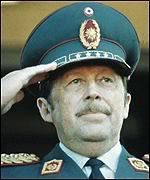
A real, nonfictional dictator (Stroessner)

This is a short reading list of Latin American novels (translated into English) that focus on dictators. These books are essential reads.

Why am I suggesting reading these books so few US readers have heard of, let alone read? What's their relevance? Why are they essential?

If you've been watching the descent of the US into authoritarianism, as I have, and you want to know something about what it might be like when a country hits bottom, there is no fiction more descriptive, more powerful than the following short list (not necessarily in order of merit) of Latin America dictator novels. These are all remarkable works of art, and can be read for that alone. That would be reason enough for reading them. But each of these books also has its dictator, and the way he acts and the way his country responds, is the essential political point in each.

*Miguel Angel Asturias, The President. The Times Literary Supplement:
"Asturias leaves no doubt about what it is like to be tortured, or what it is like to work for a man who is both omnipotent and depraved."


*Alejo Carpentier, Reasons of State
"Reflecting his deep commitment to revolutionary politics, his novels explore the irrational elements of the Latin American world, its rich variety of cultures, and the possibility of its magical transformation."
source

*Mario Vargas Llosa, Feast of the Goat. Publisher's Weekly:
"This wasn't an enemy he could defeat like the hundreds, the thousands he had confronted and conquered over the years, buying them, intimidating them, killing them." So thinks Rafael Trujillo, "the Goat," dictator of the Dominican Republic, on the morning of May 30, 1961 a day that will end in his assassination.


*Augusto Roa Bastos, I, The Supreme. Publisher's Weekly:
Power is the ruler's only interest and goal; he has neither family nor friends, only the constant presence of his secretary-confidant Patino. Bastos's relentless investigation of the depths of iniquitythat of both the "Supreme" and his antagonistsis an illuminating (and depressing) journey into the night.


*Gabriel Garcia Marquez, Autumn of the Patriarch. America:
"The Autumn of the Patriarch mines one of the darkest veins in Latin American political history. The central character is a composite of Trujillos, Batistas and Somozas. His is a genius at the barren politics of survival, capable and guilty of the most savage brutality, a lonely monster who shuffles through his palace every night, checking the locks, looking for assassins, lighting a lantern for a quick exit."


There are doubtless other books that might be added to this list. Please feel free to add them in the comments.

Note: the links are to Amazon, but if you can get these books in a local bookshop I would be far, far happier. Also, you can get most of these used on line at sites like abebooks.com.

Etiquetas: , , , ,