Magical Realism, Writing, Fiction, Politics, Haiku, Books


domingo, diciembre 11, 2011

Writers' Block, How To Escape From


by Claudia Ricci

Writing is just such a wonderful and amazing and fulfilling thing -- until one morning you wake up and can't find an ounce of motivation. You look at what you've written and suddenly it feels as dead as the heel of your right shoe.

That blank screen stares back at you, sticks out its tongue and makes funny faces. You freeze up and soon find yourself shrinking smaller than your pencil.

Then what do you do? You think about tossing your computer. Or worse, you contemplate the idea of tossing back a six-pack or a few cosmopolitans.

No. This is NOT the time to start drinking. This is not the time to start thinking dark and stormy thoughts!

There is hope. Lots of it. In fact, if you look at it the write, oops, excuse me, the right way, writer's block can be an opportunity to rethink your entire approach to writing. Writer's block can be a kind of door through which you pass through, becoming a kind of writer's revolutionary. Not only can you find new inspiration, but also, you can make some fascinating and exciting discoveries about who you are as a writer and a person and what you want to write.

If you're intrigued by these ideas, and if you want to spend a weekend by a cozy fire in a gorgeous Berkshire County inn, learning about writing from two well-seasoned fiction writers who are also both experienced college-writing teachers, then you're in for a big treat:

Please join me and my long-time writing buddy and college teaching colleague Peg Woods --otherwise known as Dr. P.M. Woods -- to get recharged. We are teaching a fabulous workshop that we're calling Writer's Bloc, a weekend-retreat February 24-26, 2012 at the very quaint Richmond Inn in Richmond, MA.

Peg and I have been college teachers of writing for almost 14 years. We've also taught a community writing workshop called "Write Your Heart Out." In both the university and community settings, we've helped many, many, many students to get started writing fiction. And we've also showed students how to get re-started and recharged, redefining what it means to have a writer's block.

You see, it's only a block if you let it stop you. We'll show you how to melt that writer's block, transforming it into an opportunity for rediscovery.

As Assistant Director of the Nationally-Recognized Writing Program at the University of Massachusetts, Amherst, Peg teaches composition and experimental creative writing classes. She is the author of numerous short stories, as well as the extraordinary novel, Spinning Will.

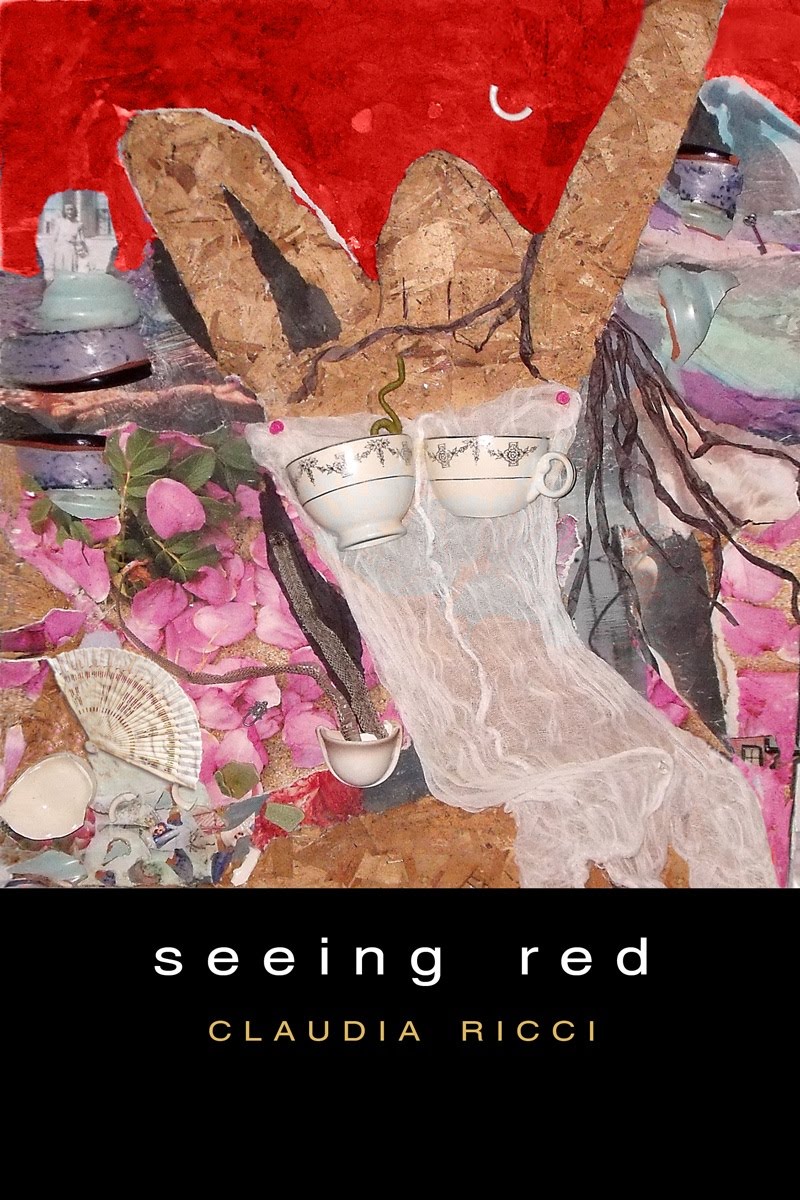
My own writing background includes many published short stories as well as the novels Dreaming Maples (nominated for a Pushcart Prize) and the new novel, Seeing Red, which was serialized in part when it appeared in January, 2011. I have been teaching English, creative writing and journalism at the University at Albany, SUNY, since 1998. More recently, I've started to paint, and to incorporate painting with words onto big and little canvases (thus all these funny-looking collages.)

It turns out that I'm not the only writer who thinks and works visually. In a great piece in The Wall Street Journal a couple of years ago, about writers and their methods of writing, author Edwidge Danticat says that before she writes a novel she puts images up on a kind of "storyboard," just the way a screenwriter might.

The writer's retreat will include exercises that involve "art" -- but no, you do NOT need to be an artist! We will also take you on an outing Saturday afternoon to the wonderful Normal Rockwell Museum in Stockbridge, MA, where we'll discuss the way art and visual images can help spark your imagination and give you more inspiration for writing.

This is going to be a lot of fun! Hey, what could be bad? You get to spend a weekend writing and meeting other writers, at a gorgeous inn in the middle of the amazing Berkshires (where by the way a slew of famous writers have lived and worked -- how about Nathaniel Hawthorne, Herman Melville, Edith Wharton?)

The February "Writer's Bloc" workshop is limited to a small number of writers, so do get in touch soon. To register, contact Retreat Coordinator Jo Ann Losinger at jolosinger@aol.com. Or phone 413.445.5874. We hope to see you there. It will be a wonderfully energizing and productive retreat, we promise you!

--------------------
cross-posted from My Story Lives.

Etiquetas: , , , ,

viernes, febrero 04, 2011

Announcing An Internet Serialized Novel


Let's face it. The book publishing industry is in the dumpster. Concentration and consolidation, the almighty bottom line, publishing on demand, electronic sales of downloadable work, all have pushed the paper book to the brink. It's time for writers to experiment and find alternative ways of bringing their work to readers.

And so, my friend Claudia Ricci's novel, Seeing Red, is the first to be serialized on Huffington Post.

In her blog, My Story Lives, she explains this surprising event:

Serializing novels in a chapter-by-chapter format isn't new. Not at all. Charles Dickens and Mark Twain and many other Victorian writers published their stories in installments in weekly and monthly magazines back in the 19th century. Readers lined up to get new installments of the novels that Dickens and others wrote.

With the book publishing business in peril, and electronic books on the rise, it seems timely to try experimenting with books on a blog! We hope you'll join us in the first Huff Post blog-book!

What follows here is the first installment (the Prologue) of Seeing Red (link warning: great music), a love story just in time for Valentine's Day.

Protagonist Ronda Cari is married and the mother of two and, oh yes, she also dances flamenco! Pretty soon she has a Spanish guitarist lover named Jesús and he's got eyes -- what else, the color of melted chocolate!

But while this book's got plenty of romance, and some decidedly hot encounters, it is definitely not a romance novel. It's a story about a woman's passion for her dancing, and her discovery that art -- and friends who do art -- can help us heal from the worst of heartbreaks.

We hope you'll take a few minutes to read the Prologue. Here's a note from a reader:

"I just finished Seeing Red and I LOVED it! I had trouble putting it down, and now I'm grieving my loss because the story is over. Seeing Red is about passion, but not only the romantic kind. I followed Ronda through Spain on her journey of love and self-discovery as she explores her marriage, motherhood, infidelity, and loss, all the while nurturing a once-forgotten passion for dance that transforms and empowers her. It is impossible not to experience Ronda's joys and pain, as well as reflect on your own, due to your gift for transporting readers via accurate and vivid details, along with your depth of insight and knowledge. I was transported, both there, AND to many personal memories. I love it when an author can do that for me -- although it is very emotional and draining, I love it." -- Kellie LaCoppola, Palatine Bridge, New York

New installments will follow three times weekly, every Tuesday, Thursday and Sunday. Enjoy!

Prologue

Later, much later, Ronda came face to face with the Spanish girl. She peered into the young woman's eyes, green and full of strange glittering light.

"What could you possibly want from me?" Ronda whispered.

The girl remained silent for a moment. But her eyes bore deeply into Ronda. She fixed her sight so tightly that Ronda felt pinned, and inside her blouse, sweat sprouted across her chest and in her armpits.

Ronda turned to Hernán, the man she had hired to drive the Mercedes. "Can you please ask her?" Ronda said. "Ask the girl what she wants from me."

Hernán nodded. Straightening up, he turned to face the girl. He cleared his throat and then, bending forward slightly, he spoke a few hurried lines of Spanish, all the while gesturing with one hand toward Ronda.

The girl lifted her head. Answered slowly. And defiantly. Hernán's eyes widened. His gaze dropped to the ground. He shook his head.

"What?" Ronda insisted. "Hernán, tell me. What does she want?"

He looked up at Ronda. He said nothing at first, as if he was deciding what to say. Finally he spoke. "She wants to know, señora, if...if when you go back to the United States, if you would be willing to take the little girl. The baby, that is. With you. To...to keep."

The words hovered around Ronda's ears, but they didn't go deeply enough. She didn't hear them. Or maybe she did, but she couldn't possibly process them, not so that they made any sense. She felt them twirling around in her brain, the same way she herself had been twirling these last months, her feet and legs learning to dance the complex steps of the alegría and the bulería and the fandango.

Ronda shuddered slightly and just stared at the girl. With no warning, the girl reached out and grabbed Ronda's hands in her own grimy hands. She held on. Despite the blazing heat, the girl's fingers were sticks of ice, as frigid as the pond back in Ronda's yard in New England.

Ronda struggled to break the fierce grip, tried to pull her hands away, but the girl just held tighter. She made one giant fist out of her own hands and Ronda's, and she shook fiercely, as if she were forcing them into a pact. Ronda shuddered again and wrenching her hands free, she stepped back.

"No..." she whispered. "Never."

She gave the girl one more look: the bronzed weather-beaten face, the green eyes, pleading.

That's when she noticed. The girl's lips. How could she not have noticed before? The lips were faintly purple now, and the pallor seemed moment by moment to be getting darker.

Ronda felt her stomach tighten. She turned toward the car, and as she did, she started to feel lightheaded.

"Hernán, I really need to...leave. Right away, we need to, please. Now."
'
Immediately Hernán was beside her, opening the door of the Mercedes and Ronda, casting one last frightened look at the greenest eyes she had ever seen, slipped inside the limousine.

Stay tuned, Chapter One is coming Sunday, Feb. 6th!!

Etiquetas: , ,

martes, marzo 03, 2009

There's A Spectre Haunting The Blogosfera

My friend Claudia, who is a wonderful writer, has a piece up at her blog and at Huffpuff, in which she asks the eternal, dreaded question for writers, "Am I getting paid for my work?" The answer, as you probably expect, isn't good:

Twice in the past week, I've heard the same bad news: two media outlets for whom I'd written articles informed me that they would not be paying me for the writing I had submitted.

One outlet is a very large and prominent city newspaper. The other is a regional magazine where I used to be paid rather handsomely, as far as freelance assignments go. Neither editor I spoke to was apologetic. Indeed, they both seemed a little surprised when I registered my objection. Somehow, they seemed to imply that I shouldn't need to be paid.
Apparently, the answer to the getting paid question is, "No, you're not. And don't ask again." If you argue, well, maybe nobody will read your work, pay or not, because it won't be put up or published. And so the Crash of 2009 has arrived like an unwanted Kashruth inspector in what Isaac Bashevis Singer called, "The Literary Factory." It's 2009. Now you produce "content," and in return you receive bupkis. OK. Maybe you get some comments. Maybe you receive a few recommends. Maybe you receive the personal warmth of a job well done. None of these is redeemable for goods at the convenience mart.

This is a serious problem. Oddly, as a writer, you own and control some of the means of your production, but, alas, you're probably producing something that can only be given away. That would mean that as far as economics is concerned it has no monetary value. It's simple. If real professionals like Claudia aren't getting checks in the mail for their work, you know that the army of volunteer scribblers and weekend web warriors aren't getting checks either. We're a large, vocal, literate mob of people who are getting nothing for their work. Nothing.

Right after I respond to this situation by writing, "Writers of the world unite, you have nothing to lose but your chains," I'm fresh out of material, I don't have the next sentence, the sentence about what we're going to do about this. I could even write, "There's a spectre haunting the blogosfera," but again, I don't have the next sentence, which should contain an answer. Oddly, I'm not sure where the machine is into which I could insert my shoe, or the machine I could throw my body in front of, or the factory I could occupy, or the plant I could strike. Put another way, nobody cares if you withhold from them a service that is worthless.

Nobody, as far as I know, at dd or Huffpuff or a dozen other medium and large size blogs gets paid anything to write. I know I sure don't. I know that I put up pieces just because I can and because I want to. I create "content" and I put it up. And if there are enough hits, maybe there's some money somewhere not to me, but to the blog owners to offset the costs of running the circus. And if there aren't enough hits, well, then maybe somebody will click the "donate" icon (mine at The Dream Antilles has never been clicked I'm sad to report, ever, not even for a single $1.00). And in the worst case, and here the worst case is the most probable, the blog owners might have to write some checks from their own, formerly obtained stash of money, to keep the blog they own from expiring. I doubt they have the moolah to write checks from the income their blogs have generated.

This state of affairs just isn't sustainable, which is a nice way of saying to writers and to blog owners alike, "Don't quit your day job(s)." If you want to write, unless things change, you're stuck. You're going to do it for free.

Claudia writes:
Which brings me back to the point of this poor-me --or better, poor us-- tale. If The New York Times is giving its news product away, doesn't that send a very important message ricocheting through our society: that news has no value? We live in a society that places a very clear value on things: we pay our baseball and movie star celebrities astronomically high salaries. We pay our day care providers and our teachers next to nothing.

Ironically, I am writing this for The Huffington Post, which makes no apologies about the fact that it doesn't pay its bloggers. When I --very politely-- asked an editor about this issue last year, he very nicely explained to me that the many hundred bloggers at the Huff Po are willing to write for free because they know their work is being seen by many millions of eyes.

That's true of course. And yes, I do see the value of having my work appear in the Huff Po. But I guess I am also old-fashioned. I was trained in an era when my work, appearing in The Wall Street Journal, earned me more than just readership. It earned me a salary. Writing, and reporting, took time. And time as we all know, is money.
To which I can add, standing on one leg like Hillel, that the rest is commentary. If news is worthless in the present system, opinion, its poor stepchild, no matter how clever or correct, is worth even less.

Etiquetas: , , , , , ,