Magical Realism, Writing, Fiction, Politics, Haiku, Books


miércoles, septiembre 09, 2009

09/09/09 And A Bird

Today's an auspicious day. Look first at the date and time. It's all nines.

I've been in Mexico for more than two weeks writing. And, thank you thank you thank you, I have finished the first draft of my novel, Tulum. And I've sent it out to two writer friends to read. I want to be sure that it's worth continuing with. It, of course, will need an agent and/or a publisher and some reworking and editing. All the usual things that turn coal into diamonds. I will get to that after my friends have read it and after I've honed it a little more.

I'm not going to spoil it now: it's about an American expat with a shady past who's been hiding in Tulum, Mexico for a decade and his making friends with a Mayan Curandero who is his neighbor. Their friendship is very playful. The book is set in Tulum, Cuba and the Mayan Riviera of Mexico. That's all I'm telling for now.

When I was in Ireland at the end of April, I received a very strong message from The Hag, The Crone to finish the first draft of this book by mid September. Or else. There would be no excuses, no extensions of time, no dogs eating my homework. The message was that I had to finish this up without further delays. So today, 9/9/09, I have met that deadline. I am relieved. I don't expect I will taste the lash that was implicit in the April message I received. Thank goodness.

I've had a wonderful solitary week of taking very long walks, swimming, and writing. The writing has required me to go on very long walks on the beach in the forest. When things were getting stiff, or sore, or congested, I stopped to walk.

Bahia Soliman, just north of Tulum, where I've been has been virtually deserted. Almost no one else is here. It is extremely quiet, and the weather has been absolutely perfect. Hot and sunny every day. In fact, the area could use some rain. We've had only one brief shower while I've been here. I am delighted to have had this produtive time here.

Throughout the week I've had repeated sightings of a particular kind of bird that keeps showing up to watch me, to hang out with me, to sing. It's called a "social flycatcher." It lives primarily in Mexico and Central America. It's a very beautiful bird:


I assume it's called "social" because it doesn't immediately fly away from people, though it does keep its distance. It has a sweet but simple song. It likes to be near the ocean, but it's also happy in the selva. And it likes to sit on wires and sing.

Since I finished my first draft I haven't seen any of these birds again. I wonder why that is.

Etiquetas: , , , , ,

domingo, noviembre 25, 2007

The Lost World of Quintana Roo


The Lost World of Quintana Roo is out of print. But you can find copies at Amazon for $22.00 and up and at abebooks.com in English and Spanish for for $15 and up (English). alibris has the book beginning at $12.00. Doubtless other used book sites and shops have the book at similar prices. This non-fiction recounting of a solo trek on foot in 1962 from what would become Cancun, all the way down the Caribbean coast of Quintana Roo, to Belise is an amazing tale. I recommend reading it.

The book resonates with me particularly because I am sure that Peissel had to walk down the pictured beach in front of my house, just north of Tulum, to reach his destination. The mangrove behind the beach would have been utterly impenetrable on foot and without assistance. Walking for days on beaches this hot and sunny without access to much fresh water would be very difficult.


What was on this beach in the early 60's? The beach was probably a cocal, a place where coconuts were grown. A caretaker (or a caretaker's family) would take care of the trees (not much is required) and collect the fruit. Boats would come by to pick up the coconuts and carry them to Cozumel or to Belise for sale. Of course, there was no electricity. And of course, there were no roads into the interior. The mangrove behind the beach is wide and deep to this day, but then there were probably more jaguars than now. And many more turtles.

The Mayan Riviera and Tulum have now become tourist destinations. People who travel there now on insane Highway 307 really have no idea what the area was like a scant 50 years ago. Peissel's book describes that beautifully.

A wonderful gift for people who have discovered and love the Mayan Riviera.

Etiquetas: , , , ,

viernes, agosto 17, 2007

Some Perspective, Please

cross posted from dailyKos

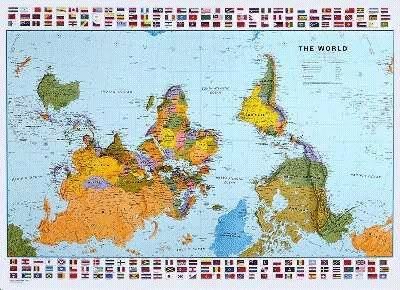
Habit is an amazing blocker of perception. It keeps thoughts within particular, constantly used, familiar channels. An example. Think for a second, if you will about what a map of the world looks like. Do you think in mercator projection? In your map, which you probably saw in classrooms, Greenland and England are enormous. And then there's this:
Photo Sharing and Video Hosting at Photobucket

There is, of course, no scientific reason why Europe and America should be at the top and Africa and South America should be at the bottom. But if we want to understand how ingrained in our thinking American exceptionalism is, the "upside down" map is a good place to begin.

There are historical reasons for perceptions. There are habitual reasons. There are artificial reasons. Sometimes we don't even recognize when our thinking is stuck in the habitual channel. The channel I'm thinking about at the moment is the belief that the US is the center of the world, that the planet revolves around the US, and that, therefore, the US is special, the US is , well, exceptional. Special.

One of the habitual thoughts most US citizens dwell on is that the rest of this hemisphere doesn't really exist, that it's essentially unimportant to us even though it is so very close to us. It is there for the US to exploit, but it is not of the same value as the US. It is somehow less, somehow not as vital, somehow not as important.

US citizens, for example, know about the destruction brought to the US by Hurricane Katrina. But fewer of us noticed that Hurricane Wilma destroyed Cancun, and even fewer of us noticed that unlike New Orleans immediate repairs to Cancun was a top priority of the government. While New Orleans still suffers, as far as I can tell Cancun has been fully repaired and, as they say, "Cancun esta de pie."

Which brings me to the present hurricane season, which has begun too soon. Tropical Storm Erin flooded Texas. We paid attention to that storm, of course, because it landed in Texas. We thought whatever thoughts we thought about how increased hurricane activity is related to global warming, and how that means that more damage might be done in the US. We thought that Erin seemed to be hitting early in the season, and maybe that meant there would be more hurricane activity this year than last year and more damage to the US.

But what of those storms that probably won't hit the continental United States, storms like Hurricane Dean, which is thrashing around in the Caribbean at this very moment? If a hurricane comes ashore in a country that is not the US, is it still a hurricane? If a tree falls in the forest, and no one...

NEW YORK (Reuters) - Hurricane Dean, which could strengthen into a Category 4 hurricane over the next two days, pounded the eastern Caribbean islands of Martinique and Dominica as it churned into the Caribbean Sea.

And next week Dean will likely enter the Gulf of Mexico, threatening the region's oil and natural gas facilities, which account for roughly a third of U.S. oil production, the National Hurricane Center predicted.

Overnight Dean strengthened into a Category 2 hurricane, with winds near 100 miles per hour

According to Reuters, it's too early to know where Dean will come ashore.
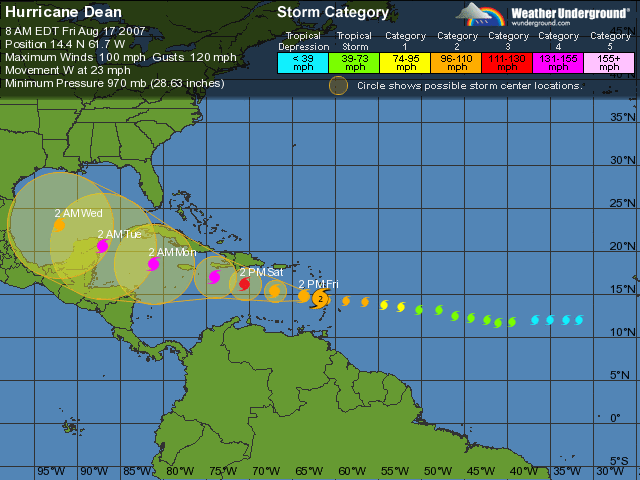
But Weatherunderground has this very disquieting map:

Photo Sharing and Video Hosting at Photobucket

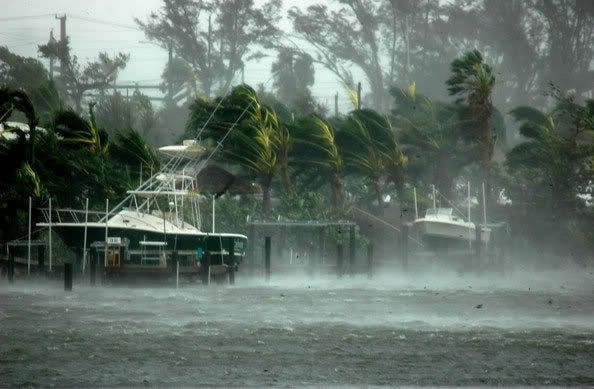
And this map looks to put Dean on a track like Hurricane Wilma, which destroyed Cancun two years ago. Maybe you can remember Wilma:

Photo Sharing and Video Hosting at Photobucket

I remember it very well. And I remember the reconstruction and what some felt was the death of the tourist industry in Quintana Roo, Mexico. But this isn't about me, or hurricanes, or Quintana Roo. Or my house in Bahia Soliman, Tulum, Municipal. Solidaridad, Quintana Roo. It's about our thinking.

Wouldn't it be amazing if when we looked at the storm map of Hurricane Dean we could recognize the connections we have with the rest of this hemisphere? Wouldn't it be remarkable if instead of looking immediately for the border between the US and Mexico, something that might disconnect us from the storm, we could perceive our connectedness? Wouldn't it be amazing if it didn't really matter to us in which country Dean was going to land? And isn't this the very shift we have to begin to make in our thinking if we want to get to the roots of American exceptionalism and dig them up?

Etiquetas: , , , ,

sábado, abril 21, 2007

The Road Past Tulum


Route 307, Quintana Roo, Mexico, 1980

When I first came here, Tulum was a dusty, little Mayan village and appeared to be just a wide spot in the narrow, two-lane road running from Cancun to Chetumal and then to the Belize border. After Tulum, there seemed to be nothing but jungle for miles. The vegetation and the mangroves were thick, the mud was often quite deep, and the plants were tall and grew right up to the side of the road and into it. Some even tried to reach into the windows of passing cars to touch the occupants or snatch them from their seats. Suicidal birds ran clucking from the sides of the road and directly into the sides of passing cars. Clouds of mosquitoes hovered, waiting for warm flesh. Lizards stood on every flat surface flicking their tongues. The village– then it was more a haphazard assemblage of weakening concrete and rusted, corrugated tin-- didn’t have restaurants and European bars and tourist shops up and down the highway. It didn’t have a bank and places to telephone the US and Europe. It didn’t really have places to telephone anywhere. It didn’t have sunburned backpackers with dreadlocks. Or tattooed and pierced Italians in the summer. That was still years away. The inhospitality should have been clear to anyone who cared to look into the situation, but there weren’t many people doing that.

--from a work in progress

Etiquetas: , , ,