Sir Salman Rushdie and Extreme Forms of Criticism
cross postsed at dailyKos
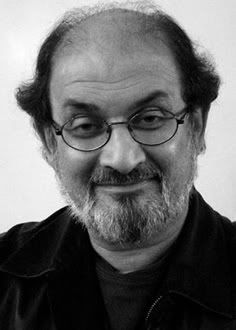
This is Sir Salman Rushdie. I've been thinking about him a lot today.
You'll recall that after he published his novel, Satanic Verses, Ayatollah Khomeni issued a fatwa condemning him to death. It seems that Satanic Verses appropriated the prophet Muhammad as a character and attributed what some thought were insulting things to him. Later, the writer VS Naipaul, one of my heroes, described the fatwah as "an extreme form of literary criticism."
It may be difficult to tell what will insult readers and even make them throw rocks. As Rushdie himself wrote in The Ground Beneath Her Feet,
"Insults are mysteries. What seems to the bystander to be the cruelest, most destructive sledgehammer of an assault, whore! slut! tart!, can leave its target undamaged, while an apparently lesser gibe, thank god you're not my child, can fatally penetrate the finest suits of armour, you're nothing to me, you're less than the dirt on the soles of my shoes, and strike directly at the heart."
Which brings me ever so cautiously to the literary and rock throwing news. This February 6, 2006, New York Times' story is as frightening as it is hard to fathom:
Demonstrations against the publication of cartoons of the Prophet Muhammad by newspapers in Europe spread across Asia and the Middle East today, turning violent in Afghanistan, where at least four protesters were killed and over a dozen police officers and protesters injured.
The protests gained momentum all over the Muslim world, a day after attacks on the Danish consulate in Lebanon and the Danish and Norwegian Embassies in Damascus, Syria, on Saturday. Muslim clerics led demonstrations in half a dozen cities in Afghanistan, and protesters turned out in Indonesia, India, Thailand, Iran, and even in New Zealand, where local newspapers recently reprinted the offending cartoons.
A teenager died in Somalia in East Africa today when police fired in the air to disperse stone-throwing protesters and set off a stampede. A crowd of about 200 people stoned and broke the windows of the Austrian Embassy in the Iranian capital, Teheran, and tried to hurl gasoline bombs inside, Reuters reported. Police with riot shields prevented further damage and the crowd dissipated after an hour, the agency reported.
And the threats of death as the result of Rushdie's Saturday knighthood. Take, as a small example, this literary criticism by Pakistan's religious affairs minister, quoted in the New York Times:
The religious affairs minister, Mohammed Ijaz ul-Haq, said in Parliament, “If someone exploded a bomb on his body, he would be right to do so unless the British government apologizes and withdraws the ‘sir’ title.”
Alas, I have worried that not enough people would read my 2005 book, The Dream Antilles. After all, Amazon has it ranked in the 400,000's today. But that seeming problem, a mix of ego, marketing and personal finance, pales compared with the idea that a few people would read my book and then thousands and thousands around the world would run into the streets trying to maim and kill people because of the affronts they perceived in it. Or that they would react in this way to some cartoons. Or the conferral of a knighthood on an author whose best work in my view was Midnight's Children, a remarkable magical realism novel paralleling the birth of India as a nation which won the 1981 Booker Prize and was later awarded the 'Booker of Bookers' Prize in 1993 as the best novel to be awarded the Booker Prize in its first 25 years. People here who know or have heard of only Satanic Verses should treat themselves to Midnight's Children. I just don't get it.
I will admit that I did smile when Mario Vargas Llosa had crowds attack the radio station in Aunt Julia and the Scriptwriter because of insults to Argentinians. I thought that was a riot, and I laughed aloud. But I am not laughing at today's news of reaction to Salman Rushdie's knighthood.
I guess I didn't realize that writing could be so dangerous. Or that criticism could be so extreme.
Etiquetas: Criticism, fatwah, salman rushdie, vargas llosa
posted by david seth michaels at 10:01 a.m.
2 comments


